Page 22 of 22

Re: Why inflation may be worse than you think it is

Posted: Wed Nov 05, 2025 3:18 am
by jusplay4fun
Instead of looking at very limited data, such as the price of gold or silver, what does the BIG PICTURE tell us about INFLATION?

Inflation now is MUCH better than under Feeble Old Joe, when, in Sept. 2022, inflation was MORE THAN Double, at 6.5 - 8%:

https://tradingeconomics.com/united-sta ... %200.3%25.

https://www.usinflationcalculator.com/i ... %202.9%203

https://www.usinflationcalculator.com/i ... 100065392/

https://www.investopedia.com/us-inflati ... nt-8546447

NOTE the graphs here, and where the worse inflation occurred since 2015.

and:

https://www.jec.senate.gov/public/index ... ion-update

Please see the graph here for CPI-U and Core CPI-U
The annual U.S. inflation rate was 3.0% in September 2025, an increase from 2.9% in August, according to the Bureau of Labor Statistics and U.S. Congress Joint Economic Committee. The Consumer Price Index (CPI) rose 0.3% month-over-month, driven primarily by a 4.1% increase in gasoline prices, though core inflation (excluding food and energy) slowed slightly to 3.0% annually.

Key data points
Annual Headline Inflation: 3.0% (September 2025)
Annual Core Inflation: 3.0% (September 2025)
Monthly Inflation: +0.3% (September 2025)
Year-over-Year Core CPI: 3.1% (August 2025)
I think that noted Economist Mookie predicted inflation under Trump:

https://www.conquerclub.com/forum/viewt ... t#p5328495

AND MORE predictions and discussions:

https://www.conquerclub.com/forum/viewt ... t#p5321592

and here was my Reponse back in 2021 to the BIDEN-CAUSED INFLATION:

https://www.conquerclub.com/forum/viewt ... t#p5231617

And note that "Bidenomics" was SUCH A SUCCESS that Biden was re-elected in 2024.....! Oh, I must have been having a brief nightmare. Thank Goodness Biden and his appointed (NOT elected) heir apparent Kamala BOTH LOST in 2024.

Re: Why inflation may be worse than you think it is

Posted: Sun Nov 09, 2025 10:14 pm
by riskllama
$6.40CDN for a 591ml bottle of sugar water(Dr. Pepper) and a 48g package of corn nuts, lol - I would've bitched, but there were two attractive women standing behind me & I didn't want to look cheap, or worse, poor... :lol: . but f*ck me, that is bloody retarded.

Re: Why inflation may be worse than you think it is

Posted: Mon Nov 10, 2025 12:18 am
by jusplay4fun
riskllama wrote:$6.40CDN for a 591ml bottle of sugar water(Dr. Pepper) and a 48g package of corn nuts, lol - I would've bitched, but there were two attractive women standing behind me & I didn't want to look cheap, or worse, poor... :lol: . but f*ck me, that is bloody retarded.
ain't life a bitch?

Re: Why inflation may be worse than you think it is

Posted: Wed Nov 12, 2025 9:17 am
by HitRed
50 year mortgages on tap?

My parents had a 30 year mortgage. I had a 20 year, paid it off in 9 years and 8 months. Housing is so expensive now realtors are mentioning 50 year mortgages. Yikes!

Re: Why inflation may be worse than you think it is

Posted: Wed Nov 12, 2025 10:07 am
by Dukasaur
It's a foul trap. A person with a 50-year mortgage is likely to pay twice as much interest over that time as a person with a 30-year mortgage.

Furthermore, it upends the life-cycle plan of many people. Right now, a person who buys a house at the age of 30 will own it free-and-clear by the time he retires. A person with a 50-year mortgage will not.

This is a desperate attempt by the Trumpists to keep pumping house prices and postpone the bursting of the real estate bubble. It won't work. The bubble is due to pop, and gimmicks won't prevent it.

Re: Why inflation may be worse than you think it is

Posted: Thu Nov 13, 2025 1:06 pm
by mookiemcgee
Dukasaur wrote:It's a foul trap. A person with a 50-year mortgage is likely to pay twice as much interest over that time as a person with a 30-year mortgage.

Furthermore, it upends the life-cycle plan of many people. Right now, a person who buys a house at the age of 30 will own it free-and-clear by the time he retires. A person with a 50-year mortgage will not.

This is a desperate attempt by the Trumpists to keep pumping house prices and postpone the bursting of the real estate bubble. It won't work. The bubble is due to pop, and gimmicks won't prevent it.
A 50 year mortgage is essentially rent for the first 15-20 years. In year one assuming 6% interest about 4% of your payment goes towards the principle and 96% goes to interest. If you have in impound account it's likely to be around 1.5-2% that goes to principle. This isn't home ownership, you have no equity, you are just renting from a bank.

Re: Why inflation may be worse than you think it is

Posted: Mon Dec 01, 2025 1:43 pm
by HitRed
Silver $58

Re: Why inflation may be worse than you think it is

Posted: Mon Dec 01, 2025 1:46 pm
by HitRed
—-

“Post by HitRed on Fri Mar 22, 2024 9:13 pm [Silver was $24.70]

Noticed silver is very cheep.

Heard
It won’t last long. - God

Re: Why inflation may be worse than you think it is

Posted: Thu Dec 11, 2025 12:33 pm
by jusplay4fun
from AI Overview:
The U.S. economic outlook for late 2025 and 2026 points to moderate growth (around 2%) but with significant volatility, driven by sticky inflation near 3%, a cooling but tight labor market, and strong consumer spending offset by AI-driven business investment, with ongoing sector rotations and potential Federal Reserve rate cuts later in 2026, though recession risks remain and fiscal deficits are a long-term concern. Key factors include AI investment, fiscal policy impacts, and global economic shifts.
Key Themes & Forecasts:
Growth: Forecasts hover around 2% for 2026, supported by consumer spending and AI investment
Sounds good, not great. This forecast is certainly better than what happened under Biden.

Rare is ALL Economic news great. On that note, the Fed tries to balance two rather conflicting goals: 1) Economic growth with low unemployment and 2) low inflation (as I have discussed before).

Re: Why inflation may be worse than you think it is

Posted: Thu Dec 11, 2025 5:37 pm
by Dukasaur
jusplay4fun wrote: Thu Dec 11, 2025 12:33 pm from AI Overview:
The U.S. economic outlook for late 2025 and 2026 points to moderate growth (around 2%) but with significant volatility, driven by sticky inflation near 3%, a cooling but tight labor market, and strong consumer spending offset by AI-driven business investment, with ongoing sector rotations and potential Federal Reserve rate cuts later in 2026, though recession risks remain and fiscal deficits are a long-term concern. Key factors include AI investment, fiscal policy impacts, and global economic shifts.
Key Themes & Forecasts:
Growth: Forecasts hover around 2% for 2026, supported by consumer spending and AI investment
Sounds good, not great. This forecast is certainly better than what happened under Biden.

Rare is ALL Economic news great. On that note, the Fed tries to balance two rather conflicting goals: 1) Economic growth with low unemployment and 2) low inflation (as I have discussed before).
That make-believe "forecast" won't age well.

Here's the real forecast:
Unemployment is rising fast. The real rate of unemployment is masked by the gig economy. A software engineer who loses his $125K/year job and goes to eke out $30K/year driving an Uber is not officially unemployed, but he's just a step away from the soup kitchen. Meanwhile, even though the official numbers hide the real damage being done, even the the official unemployment numbers are rising.
Foreclosures, 90-day credit card delinquencies, and car repossessions are all at 13-year highs. Bankruptcies will follow within the next quarter.
Food and other basic needs spiking in cost.
Fed cranking up the printing presses. Core inflation should be 5% by this time next year.
The CPI won't reflect the real inflation rate, because the meltdown in the real estate market will reduce the cost of housing, which is 40% of the CPI. So, looking at the CPI, you'll be able to claim that inflation is fairly low, but everything other than housing will be skyrocketing.
The AI bubble will burst, and the great number of people who have all their money in passive index funds will lose half of their retirement nest eggs.
The "bro" economy of young men who gamble away all their disposable income, and some of their non-disposable, will be exposed as the social poison that it is. Not only bankruptcies, but actual suicides will follow.
The government that saved nothing for a rainy day will find that its possible avenues of approach are all cut off by its hopeless fiscal situation.
Trump will force the Fed to push interest rates to zero, and he will mail out stimulus cheques to everyone, but it won't change anything. People will see the real economy crumbling, and any cash that comes through the mailbox will go to either stave off the collection agents or to necessities.

Don't waste your breath arguing. Talk to me in a year, and see which of us landed closer to the truth.

Re: Why inflation may be worse than you think it is

Posted: Thu Dec 11, 2025 11:20 pm
by jusplay4fun
Dukasaur wrote: Thu Dec 11, 2025 5:37 pm
jusplay4fun wrote: Thu Dec 11, 2025 12:33 pm from AI Overview:
The U.S. economic outlook for late 2025 and 2026 points to moderate growth (around 2%) but with significant volatility, driven by sticky inflation near 3%, a cooling but tight labor market, and strong consumer spending offset by AI-driven business investment, with ongoing sector rotations and potential Federal Reserve rate cuts later in 2026, though recession risks remain and fiscal deficits are a long-term concern. Key factors include AI investment, fiscal policy impacts, and global economic shifts.
Key Themes & Forecasts:
Growth: Forecasts hover around 2% for 2026, supported by consumer spending and AI investment
Sounds good, not great. This forecast is certainly better than what happened under Biden.

Rare is ALL Economic news great. On that note, the Fed tries to balance two rather conflicting goals: 1) Economic growth with low unemployment and 2) low inflation (as I have discussed before).
That make-believe "forecast" won't age well.

Here's the real forecast:
Unemployment is rising fast. The real rate of unemployment is masked by the gig economy. A software engineer who loses his $125K/year job and goes to eke out $30K/year driving an Uber is not officially unemployed, but he's just a step away from the soup kitchen. Meanwhile, even though the official numbers hide the real damage being done, even the the official unemployment numbers are rising.
Foreclosures, 90-day credit card delinquencies, and car repossessions are all at 13-year highs. Bankruptcies will follow within the next quarter.
Food and other basic needs spiking in cost.
Fed cranking up the printing presses. Core inflation should be 5% by this time next year.
The CPI won't reflect the real inflation rate, because the meltdown in the real estate market will reduce the cost of housing, which is 40% of the CPI. So, looking at the CPI, you'll be able to claim that inflation is fairly low, but everything other than housing will be skyrocketing.
The AI bubble will burst, and the great number of people who have all their money in passive index funds will lose half of their retirement nest eggs.
The "bro" economy of young men who gamble away all their disposable income, and some of their non-disposable, will be exposed as the social poison that it is. Not only bankruptcies, but actual suicides will follow.
The government that saved nothing for a rainy day will find that its possible avenues of approach are all cut off by its hopeless fiscal situation.
Trump will force the Fed to push interest rates to zero, and he will mail out stimulus cheques to everyone, but it won't change anything. People will see the real economy crumbling, and any cash that comes through the mailbox will go to either stave off the collection agents or to necessities.

Don't waste your breath arguing. Talk to me in a year, and see which of us landed closer to the truth.
NAW, I accept your challenge. NO need for me to waste my time; I can argue this all day long. AND I have to wait ONLY ONE year to prove my point? Why not wait 5 or 10 years??? NAW, I will argue it HERE AND NOW.

and NOTE that there are NO Source cited by Duk, so who is using
make-believe "forecast"
??? And Duk claims his crystal ball is better than mine?? because...?? again, he did not cite his sources, so we can argue crystal balls all day long.

And it is a crystal ball, yours and mine, are not a guarantee of what will happen.

AND the data used for predictions is limited NOW, due to the Schumer Shut-down of the Federal Government over ObamaCare. This includes the crystal ball used by the Fed (the Federal Reserve Board).

The
real economy crumbling
?? What real economy? The one that Biden predicted? Are you saying a major depression will occur? Is that what you want so that your predictions, predicated partly by your TDS, will happen??

and you claim
Food and other basic needs spiking in cost.
A small increase in food since January is NOT spiking, NOT compared to the inflation caused by Biden.
How has the price changed since before the pandemic?
Up 29% since February 2020, according to the Bureau of Labor Statistics.
(NPR)
https://www.npr.org/2025/09/19/nx-s1-55 ... -inflation

and
As recently as August 2022, the rate of inflation for food at 11.4% was the highest since May 1979.
https://www.usinflationcalculator.com/i ... ed-states/

MORE data at the above website; including the REAL and ACTUAL food spike in 2022 under "Bidenomics." The current yearly inflation of food since August 2024 (before Trump II) is 3.1%, much less than under Biden. The overall annual inflation rate is about 3% now.

And Duk uses HYPERBOLE to exaggerate the inflation under Trump in the past 11 months or so. The US Economy is too complex is to relate ONE number to another to show definitive causality.

and now Duk claims the data is NOT REAL data:
The CPI won't reflect the real inflation rate
As I said, one can a number (stat) or 3 CANNOT be used to argue the US Economy is doing (Pick ONE: Great, good, fair, bad, or horrible). What type of number are you looking for? BUT Duk also claims an overall number (CPI) is not really accurate. So somehow his numbers are better and the "real numbers" (actual Stats, CPI, by the Government) is NOT accurate. Does this sound like a person talking out of BOTH sides of his mouth?

Duk will next claim the sky is falling. NEXT, Duk will also attempt to link that to Trump's tarriffs on Canadian goods.

There may be a handful of people trying to avoid
stave off the collection agents
Not everyone is that close to bankruptcy. As an aside, I see LOTS of young people get food sent to their place of work via UBER East OR Grub Hub or other food delivery service. AND for McDonald's? They want to spend $10 to have a $15 lunch delivered? They need to learn to better manage their money. Some of these folks, especially young people are almost as profligate as the Federal Government.

You need better arguments, better forecasts, less hyperbole, and reliable and cited sources, Duk. SO far, my sources TRUMP yours, before and after your previous post.

Re: Why inflation may be worse than you think it is

Posted: Wed Dec 17, 2025 12:14 pm
by Dukasaur
jusplay4fun wrote: Thu Dec 11, 2025 11:20 pm again, he did not cite his sources
No, and I'm not going to. I listen to at least two hours of financial and economic analysis on the average day, probably 20% from radio stations and about 80% from podcasts. And no, I'm not in some partisan echo chamber. I range very freely -- I listen to liberals and conservatives, libertarians and socialists, anarchists and mainstream corporate execs, Austrian-school economists and Marxists, Keynsians and anti-Keynsians, etc., etc. You name your flavour of economist, and I've listened to them. (And just as a minor aside, after being a libertarian activist for several years and becoming very well versed in economics, I took economics purely as a recreational credit at our local university, got 95% in Micro and 93% in Macro, so I think I know what I'm talking about.)

So, yeah, I learn an awful lot about the economy, immerse myself in it for two hours a day on average, but there's no way I can provide links. Some of the stuff is on the radio and can't be linked. The podcasts I listen to I could, in theory, link to, if I had the tech skills, but I don't and even if I figured out how to do it, you wouldn't bother listening to it anyway. You refuse to watch 10-minute videos when people post them, so I don't imagine you'd take the time to listen to the in-depth 90-minute podcasts I listen to. And most of the time I don't even remember the names of the various speakers, and since obviously I'm driving when listening, I can't even take notes. Not that you'd care if I did.

So sorry. I come here for fun not profit. I could spend hours finding citations and posting them for you to ignore, but I honestly don't care if you believe me. My predictions stand. Within the next 12 months they will all unfold.

Dukasaur wrote: Thu Dec 11, 2025 5:37 pm Unemployment is rising fast. The real rate of unemployment is masked by the gig economy. A software engineer who loses his $125K/year job and goes to eke out $30K/year driving an Uber is not officially unemployed, but he's just a step away from the soup kitchen. Meanwhile, even though the official numbers hide the real damage being done, even the the official unemployment numbers are rising.
Foreclosures, 90-day credit card delinquencies, and car repossessions are all at 13-year highs. Bankruptcies will follow within the next quarter.
Food and other basic needs spiking in cost.
Fed cranking up the printing presses. Core inflation should be 5% by this time next year.
The CPI won't reflect the real inflation rate, because the meltdown in the real estate market will reduce the cost of housing, which is 40% of the CPI. So, looking at the CPI, you'll be able to claim that inflation is fairly low, but everything other than housing will be skyrocketing.
The AI bubble will burst, and the great number of people who have all their money in passive index funds will lose half of their retirement nest eggs.
The "bro" economy of young men who gamble away all their disposable income, and some of their non-disposable, will be exposed as the social poison that it is. Not only bankruptcies, but actual suicides will follow.
The government that saved nothing for a rainy day will find that its possible avenues of approach are all cut off by its hopeless fiscal situation.
Trump will force the Fed to push interest rates to zero, and he will mail out stimulus cheques to everyone, but it won't change anything. People will see the real economy crumbling, and any cash that comes through the mailbox will go to either stave off the collection agents or to necessities.

Don't waste your breath arguing. Talk to me in a year, and see which of us landed closer to the truth.
Just a couple of comments about the things you said:
jusplay4fun wrote: Thu Dec 11, 2025 11:20 pm
Up 29% since February 2020, according to the Bureau of Labor Statistics.
(NPR)
https://www.npr.org/2025/09/19/nx-s1-55 ... -inflation
From your own quoted source:
Last month saw the biggest jump in grocery prices in almost three years.
(August 2025)

Inflation was high early in the Biden administration, but calming through the end of it. Inflation stayed between 2 and 2.5 percent during the last year of Biden and the first six months of Trump, but in Q3 of 2025 began re-accelerating. It will be at least 5% a year from now.

This isn't really a Trump/Biden thing, as much as you would like it to be. Obama and Bush were pretty bad, too. Trump is the worst of the bunch, but the others were no angels. And of course, presidents can't pass bad budgets without Congress, so Congress has to shoulder the blame, too. There really hasn't been anybody, in either party, seriously talking about slowing down the printing presses in more than two decades. The last time the U.S. had a balanced budget was the period 1998-2001. And Congress can't print money without the connivance of the Fed, so the Fed has to get its share of the blame for being the Great Enabler, and buying the Treasury's toilet paper.

Moving on...
jusplay4fun wrote: Thu Dec 11, 2025 11:20 pm AND the data used for predictions is limited NOW, due to the Schumer Shut-down of the Federal Government over ObamaCare. This includes the crystal ball used by the Fed (the Federal Reserve Board).
Actually, that's a bullshit excuse that Powell is using. Private data, especially the ADP, was available throughout the shutdown. Fed insiders admit (strictly off-the-record, of course) that ADP data is usually more accurate that BLS data, at least in the immediate moment, before the BLS data goes through its six month cycle of revisions.

Most of the stuff about the slowing economy is visible through data that doesn't depend on government. You can see the rising trend of credit card defaults, mortgage defaults, and car reposessions through stuff released by realty associations, credit bureaus, etc. I don't want to waste a lot of time digging up citations for you, but just for a very quick example here's what you can see:
https://www.usatoday.com/story/money/pe ... 094248007/
The national FICO score, or three-digit number used to summarize your credit report, fell two points to 715 from last year, the credit scoring services company said in its inaugural FICO Score Credit Insights report. The decline was driven by rising credit card utilization and a spike in missed payments, partly due to resumed student loan delinquency reporting, FICO said.

Many consumers had relied more heavily on credit cards to make ends meet, driving average credit card utilization in 2025 to 35.5%, up from 29.6% in 2021.
You may think a two-point drop in FICOs is pretty trivial, but it represents about 200 billion in extra indebtedness amongst consumers. And of course, that snowballs. 200 billion now will be 250 billion in a year, and 325 billion in two years, etc., etc. And all that is independent of other downdrafts in the economy.

Enough for today.

Re: Why inflation may be worse than you think it is

Posted: Fri Dec 19, 2025 4:31 pm
by jusplay4fun
I will allow Duk not to cite all or even some of his sources for the point of discussion here, since I trust that most of what Duk cites is largely of a reliable Economic value. I will add the Economic interpretation of data is often prejudiced by one's economic beliefs (Keynesian vs. monetarist, for the most part). So I can and will likely NOT agree with all of Duk's assessments and his data and his conclusions. I will not challenge each data point or prediction as I do not think such efforts by me will advance the discussion here. It will certainly NOT prove if Duk is more wrong than I am; nor will it prove that Duk's Economic ideas are more valid than mine. AND EVEN IF some of Duk's predictions come true in ----- Months (pick one: 6, 12, 24), that does not mean the Duk has the actual caused linked ("causal link") and proven his analysis. As described in the next paragraphs, such correlations are not definitive.

Well, Duk, I am well versed on Economics, as are you. I do not claim to be an expert so I cite my sources, because I do not immerse myself in Economic data and podcasts and analysis. I would rather have fun interacting with important people in my life (family and friends) and leading a Clan on CC, and reading, and enjoying life, and teaching young people, mostly in Chemistry and Physics. I watch the US Economy mostly because it is of interest to me, but, again, I am not an expert, do not have a degree in Economics, but did consider that option in life. The MAIN reason I did not was that while Chemistry and Physics are "Hard Science" based on data and empiricism and solid theories and actual laws (such as the Law of Mass Action and Law of Gravity, to name only two), Economics is NOT a "HARD Science." I discussed this very point a while back.

Economics, being a "Soft" or Social Science does not have the certainty and is subject to subjective measures; Experiment cannot prove one Economic Theory over the other. The MAIN Debate is between Keynesian and monetarist ideas on Economic theories and both are valid and neither side can disprove the other.

I do teach students about correlation of data and discuss correlation vs. causality. Most Economic theory is based on correlation; economic causality is NOT definitive.

With all that said, the US Economy (more so that more socialist Economies of the many nations) is very dynamic and evolving. The US Economy does not have the "braking" or limiting impacts of an Economy such as Sweden with large amounts of Government spending dictating (or significantly limiting) economic growth. My understanding is that most European Economies are more regulated and more socialistic than the US Economy. BUT the US Economy has elements of Socialism, started largely under FDR as he attempted to pull the US out of its Great Depression. (And many/some argue, as I have read recently, that the actions of FDR actually lengthened the US Depression; it took WWII to actually end the US Depression, by and large.)

I think the US and Canadian Economies are Capitalistic and has a large amount of Socialism that means we both have a large safety net for citizens who are not as well-off.

NOW Duk (and other more liberal posters here in CC) were predicting economic calamity due to Trump's policies as they relate to tariffs, in particular. They were calling for a falling "sky" and that has NOT happened. I will now cite at least one source of several that I have read in recent days as I continue to try to better understand Economic matters. After HitRed reminded me of the importantce of the M2 money supply, I did more research on that matter, too.
2. The macroeconomic impact was predictable
The rule of thumb that many have used as a benchmark is that a 1% increase in tariffs will raise inflation by 10 basis points and hinder GDP growth by 5 basis points. Since tariffs were roughly 2% last year and are about 11% now, that translates into 0.8% on inflation and 0.4% on growth.

How does that compare to what we‘ve seen? There was a meaningful weakening in gross domestic product (GDP) growth during the first half of the year, much of it attributable to the turmoil around tariffs and trade. Consensus estimates for full-year GDP are now roughly 0.6 percentage points lower than they were during the lead up to Liberation Day. There are many other factors that affect GDP growth, but we believe a big slice of the downgrade is due to the uncertainty around trade.

For inflation, it’s reasonable to ascribe at least a few tenths of a percent of the current 2.9% inflation to cumulative tariff effects. Many forecasts suggest a slight uptick in inflation in the months ahead, even while we are seeing a slowdown in key areas such as housing and the labor market. We believe a good amount of the inflation increase is tariff related, which means that we‘re probably not that far off the rule of thumb estimates.(...)

Neither of these points spell an impending recession, in our view. Imports of goods are only 11% of U.S. GDP, so it would probably take something akin to “Liberation Day: Part 2” to really sink the U.S. economy. However, it does mean that inflation and growth are both being pushed in the wrong direction. It is difficult to determine the exact impact on consumer prices since the general weakening of the economy is pushing inflation in the other direction. This might allow some pundits to argue that tariffs don’t raise prices. But it’s still there in the underlying data and should give Federal Reserve officials cause for concern as the pressure for interest rate cuts increases.
https://www.capitalgroup.com/advisor/in ... onomy.htmland
It is worth noting that the economy is complex. As the impacts of tariffs ripple through the economy, other factors, like employment, interest rates and more can come into play and affect the economic state of the country.

Some impacts have been more directly linked to tariff costs. For example, in California, the governor’s office reported that businesses in the state incurred $11.3 billion in tariff costs from January to May 2025, which represents the highest burden of any state in the country. (10)
https://moneywise.com/news/economy/trum ... data-shows

I think Mookie would argue that his state of California has been hurt by tariffs. Furthermore, the trade disruptions may have hurt his wine business, but I was under the impression that most of his wines were sold in the US and not exported, but he never really mentioned that, to my recollection.

I have argued about the complex nature of the US Economy, so this quote offers another validation of my previous statements to that fact.

https://moneywise.com/news/economy/trum ... data-shows

and more:
Of course, some goods are hit harder by price increases than others. For example, apparel, coffee, tea and cameras have each seen prices rise by over 7%. Likewise, some sectors are seeing more impacts than others. (17)

For example, manufacturing might expand by 2.5% but the construction sector is expected to shrink by 3.8%. The agriculture industry is already seeing the impacts of tariffs on commodities like soybeans, with prices going up in response to retaliatory tariffs put in place by China. (18, 19, 20)
I think Mookie and/or Duk was arguing that the manufacturing sector was being hurt by Trump (or losing jobs; I cannot recall the EXACT point they were making, without reading more than I want to read in previous posts). This source predicts CONTRARY to what they were saying. To simplify, I think that both Duk and Mookie predicted that the "sky was falling." Clearly the US Economy met some "headwinds" but did not crash or have the dire outcomes they predicted in Nov 2024 or Jan 2025.

In reading more data and analysis, I think it is safe to say:
1) lots of uncertainly on inflation and economic activity;
2) Some inflation (in the range of 2-3%) is likely;
3) Some economic improvement is likely (also in the 2-3% improvement in the GDP).

I think if the Fed and FOMC did not did not have confidence in their forecasts, they would NOT have reduced the Prime (interest rate) as they did for the month of December.
Federal Reserve lowers its benchmark interest rate by 0.25 percentage points in third straight cut
By Aimee Picchi
Updated on: December 10, 2025 / 3:59 PM EST / CBS News

The Federal Reserve on Wednesday cut its benchmark interest rate by 0.25 percentage points, bringing the federal funds rate to its lowest level in more than three years.

The reduction lowers the federal funds rate — what banks charge each other for short-term loans — to between 3.5% and 3.75%, down from its prior range of 3.75% to 4%. The Fed's decision marks the third consecutive rate cut since September, lowering the federal funds rate by a total of 0.75 percentage points this year.

Despite the lack of key government economic data because of the recent U.S. government shutdown, the Fed has been closely monitoring the slowdown in monthly job growth as well as rising inflation. Figures from ADP, which tracks private payrolls, showed that employers shed 32,000 jobs in November, a signal of continuing headwinds in the labor market.
https://www.cbsnews.com/news/federal-re ... me-powell/

Re: Why inflation may be worse than you think it is

Posted: Fri Dec 19, 2025 5:03 pm
by jusplay4fun
Duk said:
Most of the stuff about the slowing economy is visible through data that doesn't depend on government. You can see the rising trend of credit card defaults, mortgage defaults, and car reposessions through stuff released by realty associations, credit bureaus, etc. I don't want to waste a lot of time digging up citations for you, but just for a very quick example here's what you can see:
https://www.usatoday.com/story/money/pe ... 094248007/

I have NO DOUBT that some are being hurt in the Current economic conditions. BUT not everyone is doing poorly and much depends on jobs and geography and what part/sector of the Economy the person(s) (head(s) of households are IN). NOT everyone is hurt and NOT all the working poor are hit equally hard.

A few more points:
1) ObamaCare (ACA) is a terribly designed program and the country needs to fix it. Simply throwing more MONEY is, as Schumer, Jeffries, and many Democrats want, IS NOT THE SOLUTION.

2) Growing up, I was told to get a good education and get a good job (with benefits of health care and other fringe benefits, such as retirment benefits). I followed that advice and so did ALL my siblings. We ALL have earned college degrees and most of us have a professional degree and WE ALL do well. We achieved the "American Dream" that our parents wanted for us and encouraged us to follow. The fact that we are intelligent, hard-working, have good people skills, and avoid the "sins of alcohol and drugs" have allowed us ALL to be successful. We are NOT perfect, but we are, by MOST measures, successful. We sacrificed, saved money, were diligent in watching our spending, and worked very hard at our jobs for many years. The same is largely true of my wife's siblings, but ONE did have alcohol issues and is not as successful.

3) Those who did not sacrifice and did not work as hard (and did not earn an education, and did not save money to be more successful) DID not achieve our level of success. AND THAT should NOT SURPRISE anyone. We achieved, and we are willing to pay some taxes to help others who are not as fortunate and successful as others.

4) BUT let those who CAN actually WORK to EARN their bread (i.e., food) and their health insurance; do allow those less successful folks to depend ENTIRELY on government handouts. That teaches self-defeating values.

5) What is STILL the best way to be successful? Get a good education and get a good job. Avoid alcohol, substance abuse, crime, (and for females) avoid pregnancy as a teen.
The Success Sequence. Social scientists have long observed a simple, three-step behavioral pattern that dramatically lowers the risk of poverty: graduate from high school, secure full-time employment, and marry before having children. This pattern, known as the success sequence, is not a guarantee of success. But the numbers are striking. Ninety-seven percent of Americans who follow all three steps avoid poverty by age 30. (...)

Research consistently shows that marriage boosts upward mobility, even when controlling for education and income. For example, a child born to a married mother with only a high school diploma is three times more likely to graduate from college than a child born to an unmarried mother with the same level of education.
https://www.city-journal.org/article/po ... t-marriage

and, MORE info:
https://www.self.inc/blog/7-tips-for-br ... of-poverty

https://partnersinfire.com/finance/pro- ... -lived-it/

Re: Why inflation may be worse than you think it is

Posted: Sun Dec 21, 2025 3:13 pm
by Dukasaur
jusplay4fun wrote: Fri Dec 19, 2025 4:31 pm I will allow Duk not to cite all or even some of his sources for the point of discussion here, since I trust that most of what Duk cites is largely of a reliable Economic value. I will add the Economic interpretation of data is often prejudiced by one's economic beliefs (Keynesian vs. monetarist, for the most part). So I can and will likely NOT agree with all of Duk's assessments and his data and his conclusions. I will not challenge each data point or prediction as I do not think such efforts by me will advance the discussion here. It will certainly NOT prove if Duk is more wrong than I am; nor will it prove that Duk's Economic ideas are more valid than mine. AND EVEN IF some of Duk's predictions come true in ----- Months (pick one: 6, 12, 24), that does not mean the Duk has the actual caused linked ("causal link") and proven his analysis. As described in the next paragraphs, such correlations are not definitive.

Well, Duk, I am well versed on Economics, as are you. I do not claim to be an expert so I cite my sources, because I do not immerse myself in Economic data and podcasts and analysis. I would rather have fun interacting with important people in my life (family and friends) and leading a Clan on CC, and reading, and enjoying life, and teaching young people, mostly in Chemistry and Physics. I watch the US Economy mostly because it is of interest to me, but, again, I am not an expert, do not have a degree in Economics, but did consider that option in life. The MAIN reason I did not was that while Chemistry and Physics are "Hard Science" based on data and empiricism and solid theories and actual laws (such as the Law of Mass Action and Law of Gravity, to name only two), Economics is NOT a "HARD Science." I discussed this very point a while back.

Economics, being a "Soft" or Social Science does not have the certainty and is subject to subjective measures; Experiment cannot prove one Economic Theory over the other. The MAIN Debate is between Keynesian and monetarist ideas on Economic theories and both are valid and neither side can disprove the other.

I do teach students about correlation of data and discuss correlation vs. causality. Most Economic theory is based on correlation; economic causality is NOT definitive.

With all that said, the US Economy (more so that more socialist Economies of the many nations) is very dynamic and evolving. The US Economy does not have the "braking" or limiting impacts of an Economy such as Sweden with large amounts of Government spending dictating (or significantly limiting) economic growth. My understanding is that most European Economies are more regulated and more socialistic than the US Economy. BUT the US Economy has elements of Socialism, started largely under FDR as he attempted to pull the US out of its Great Depression. (And many/some argue, as I have read recently, that the actions of FDR actually lengthened the US Depression; it took WWII to actually end the US Depression, by and large.)

I think the US and Canadian Economies are Capitalistic and has a large amount of Socialism that means we both have a large safety net for citizens who are not as well-off.
Pretty reasonable summation. Nothing I really want to dispute there.
jusplay4fun wrote: Fri Dec 19, 2025 4:31 pm NOW Duk (and other more liberal posters here in CC) were predicting economic calamity due to Trump's policies as they relate to tariffs, in particular. They were calling for a falling "sky" and that has NOT happened. I will now cite at least one source of several that I have read in recent days as I continue to try to better understand Economic matters. After HitRed reminded me of the importantce of the M2 money supply, I did more research on that matter, too.
2. The macroeconomic impact was predictable
The rule of thumb that many have used as a benchmark is that a 1% increase in tariffs will raise inflation by 10 basis points and hinder GDP growth by 5 basis points. Since tariffs were roughly 2% last year and are about 11% now, that translates into 0.8% on inflation and 0.4% on growth.

How does that compare to what we‘ve seen? There was a meaningful weakening in gross domestic product (GDP) growth during the first half of the year, much of it attributable to the turmoil around tariffs and trade. Consensus estimates for full-year GDP are now roughly 0.6 percentage points lower than they were during the lead up to Liberation Day. There are many other factors that affect GDP growth, but we believe a big slice of the downgrade is due to the uncertainty around trade.

For inflation, it’s reasonable to ascribe at least a few tenths of a percent of the current 2.9% inflation to cumulative tariff effects. Many forecasts suggest a slight uptick in inflation in the months ahead, even while we are seeing a slowdown in key areas such as housing and the labor market. We believe a good amount of the inflation increase is tariff related, which means that we‘re probably not that far off the rule of thumb estimates.(...)

Neither of these points spell an impending recession, in our view. Imports of goods are only 11% of U.S. GDP, so it would probably take something akin to “Liberation Day: Part 2” to really sink the U.S. economy. However, it does mean that inflation and growth are both being pushed in the wrong direction. It is difficult to determine the exact impact on consumer prices since the general weakening of the economy is pushing inflation in the other direction. This might allow some pundits to argue that tariffs don’t raise prices. But it’s still there in the underlying data and should give Federal Reserve officials cause for concern as the pressure for interest rate cuts increases.
https://www.capitalgroup.com/advisor/in ... onomy.html
All that is probably pretty close to the consensus. Overall tariffs have gone up about 9 percent, representing a small positive impulse to inflation and a small negative impulse to growth. The U.S. has a fairly high domestic supply of most things, so in purely financial terms it can afford relatively high tariffs without industries grinding to a halt. A few things I would like to add to that, however.

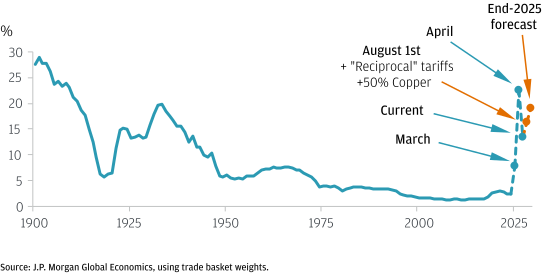
First and foremost, it is necessary point out that tariffs only went up by 9 points because Trump chickened out on most of his threats. Had he carried out all his threatened tariffs, the actual damage would have been double or triple what it has been.
Image

It's true that the sky didn't fall, but it only failed to fall because trump chickened out.

Second, it needs to be said that the effect of the tariffs is not just economic. There's a massive geopolitical impact. Trump's trade wars were not launched against America's enemies, they were largely launched against America's friends. Canada, for instance, has been a faithful ally through two world wars and many lesser wars. The Canadian steel and aluminum industries were considered an integral part of the U.S. defense establishment. Now those same steel and aluminum producers that have helped build your planes and warships for 100 years are teetering on the brink of insolvency due to the sudden and unprovoked trade war, and Canadians are taking it personally. People who vacationed in Florida aren't going this year. They're willingly taking losses and selling their Florida condos at a loss rather than support the American economy. There's a very visceral and personal sense of betrayal there.

I can only speak authoritatively about what's happening in Canada, but I read about similar feelings being felt in Japan and Britain and Denmark and Italy. These trade wars are not just burning America's trade standing, but its geopolitical standing also. The sudden tariff on pasta, for instance. 90% of your pasta is domestically-manufactured. The tiny amount that you import from Italy, mainly for high-end gourmet restaurants, is insignificant economically. And yet, hammering it with punitive tariffs was seen as a personal insult by Italians. In America, nobody outside of the hospitality business even noticed, but in Italy it was front-page news. For a few thousand dollars, you have pissed off millions of citizens of an important military ally.

Third, my dire economic forecast for you was not based primarily on tariffs. The second major leg of Trumpism -- abuse and deportation of immigrants, is even greater in its impact. On this there is no significant disagreement. There are costs associated with immigration for sure, but the long-term benefits always outweigh the costs. There is no major disagreement on this from any economist Left, Right or Centre. Immigrants are the reason why the U.S. is the amazing economic powerhouse that it is. Here's a basic primer on the subject from the George W. Bush Institute: https://www.bushcenter.org/catalyst/nor ... eigh-costs. Immigrants are always more industrious, more motivated, more flexible than locally-born workers. So far, Trump has deported 400,000 of America's most productive workers and has another 50,000 in jail awaiting deportation. But more importantly, another 1.6 million have self-deported rather than face being beaten and dragged off to a cell. Overall, that's 2 million participants in the economy, some bad people no doubt, but mostly hard-working and law-abiding people. That's a brutal blow to the economy. You've already seen the damage in things like the Tricolor Holdings bankruptcy.

So that covers the decline in the economy. It's not actually the biggest headwind. The biggest headwind is that you have three massive bubbles -- AI stocks, real estate, and private credit. (Many commentators conflate them into one, called the "Everything Bubble.") Any one of the three could pop at any minute, and like dominoes, once one pops, the others will also.

It's not actually Trump's fault that the Everything Bubble is due to pop during his term, but what is his fault is that he keeps pressuring the Fed to continue to blow more air into the bubble. And, although Powell has tried to resist, he has started to give in. A bubble bursting is always painful, but the longer you pump it, the worse it gets. And I don't think there's any chance they'll turn back now.

They've continued retreating back to ridiculously low interest rates, but furthermore, they have now restarted QE. (Although they're not calling it QE, of course. Another smoke-and-mirrors renaming.)
https://thecmigroup.ca/press-room/fed-r ... ve-easing/
20 billion a month in purchasing Treasury toilet paper.

Once again, more to say but out of time. Enough for today.

Re: Why inflation may be worse than you think it is

Posted: Sun Dec 21, 2025 3:36 pm
by jusplay4fun
Let me respond to at least one of Duk's points in his latest post, without quoting ALL of it:
First and foremost, it is necessary point out that tariffs only went up by 9 points because Trump chickened out on most of his threats.
What you call "Trump chickened out" is part of the overall strategy to use the THREAT of high tariffs to negotiate BETTER trade deals. Many nations have restricted American access to their markets while wein the USA have not acted in a simlar manner. I see the USE of tariffs by Trump to MAKE EVEN the trade field. The world is NOT all of how you spin reality and TRUTH, Duk.

I cannot address how most nations view Trump's actions. I am sure many are not happy. I will say that Europe does NEED to assume more RESPONSIBILITY and MORE SPENDING for THEIR OWN Defense. That is beginning to happen NOW. THe Marshall Plan is OVER.

I have addressed some of the immigration issues already and there is NO NEED for me to restate those here.

It is UNCLEAR what you cited graph shows as it is NOT titled and the y-axis (VERTICAL) is NOT Labeled. Is it the tariff rate?

Re: Why inflation may be worse than you think it is

Posted: Sun Dec 21, 2025 6:04 pm
by Dukasaur
jusplay4fun wrote: Sun Dec 21, 2025 3:36 pm
It is UNCLEAR what you cited graph shows as it is NOT titled and the y-axis (VERTICAL) is NOT Labeled. Is it the tariff rate?
Yes. U.S. tariffs, averaged across all sectors.

Re: Why inflation may be worse than you think it is

Posted: Mon Dec 22, 2025 1:06 am
by jusplay4fun
Dukasaur wrote: Sun Dec 21, 2025 6:04 pm
jusplay4fun wrote: Sun Dec 21, 2025 3:36 pm
It is UNCLEAR what you cited graph shows as it is NOT titled and the y-axis (VERTICAL) is NOT Labeled. Is it the tariff rate?
Yes. U.S. tariffs, averaged across all sectors.
Thanks for the clarification, Duk. However, basically that does not negate or refute anything else I stated in the rest of that post.

Re: Why inflation may be worse than you think it is

Posted: Mon Dec 22, 2025 1:34 am
by mookiemcgee
Sometimes i catch myself writing up a thoughtful and detailed posts, but then I remember these retards won't even acknowledge that free trade is a good thing, or that tariffs are taxes on your own consumers. Somehow retards that have been decrying gov't taxes for their whole lives, suddenly want to have a wait and see approach because tRumP iS a bUsInEsS mAN.

Re: Why inflation may be worse than you think it is

Posted: Mon Dec 22, 2025 7:16 pm
by Dukasaur
mookiemcgee wrote: Mon Dec 22, 2025 1:34 am Sometimes i catch myself writing up a thoughtful and detailed posts, but then I remember these retards won't even acknowledge that free trade is a good thing, or that tariffs are taxes on your own consumers. Somehow retards that have been decrying gov't taxes for their whole lives, suddenly want to have a wait and see approach because tRumP iS a bUsInEsS mAN.
Yeah.

Re: Why inflation may be worse than you think it is

Posted: Tue Dec 23, 2025 9:21 am
by HitRed
US GDP rises to 4.3% in 3rd quarter.

https://www.kitco.com/news/article/2025 ... ises-43-q3

Re: Why inflation may be worse than you think it is

Posted: Tue Dec 23, 2025 1:30 pm
by HitRed
https://www.foxnews.com/travel/historic ... ng-battles


"Beginning in the New Year — on Feb. 1, 2026, to be exact — foreign visitors will have to pay about $2.35 (€2) to visit the Trevi Fountain.

The Eternal City introduced a new tariff system for its museums and monuments on Dec. 18."