I will allow Duk not to cite all or even some of his sources for the point of discussion here, since I trust that most of what Duk cites is largely of a reliable Economic value. I will add the Economic interpretation of data is often prejudiced by one's economic beliefs (Keynesian vs. monetarist, for the most part). So I can and will likely NOT agree with all of Duk's assessments and his data and his conclusions. I will not challenge each data point or prediction as I do not think such efforts by me will advance the discussion here. It will certainly NOT prove if Duk is more wrong than I am; nor will it prove that Duk's Economic ideas are more valid than mine. AND EVEN IF some of Duk's predictions come true in ----- Months (pick one: 6, 12, 24), that does not mean the Duk has the actual caused linked ("causal link") and proven his analysis. As described in the next paragraphs, such correlations are not definitive.
Well, Duk, I am well versed on Economics, as are you. I do not claim to be an expert so I cite my sources, because I do not immerse myself in Economic data and podcasts and analysis. I would rather have fun interacting with important people in my life (family and friends) and leading a Clan on CC, and reading, and enjoying life, and teaching young people, mostly in Chemistry and Physics. I watch the US Economy mostly because it is of interest to me, but, again, I am not an expert, do not have a degree in Economics, but did consider that option in life. The MAIN reason I did not was that while Chemistry and Physics are "Hard Science" based on data and empiricism and solid theories and actual laws (such as the Law of Mass Action and Law of Gravity, to name only two), Economics is NOT a "HARD Science." I discussed this very point a while back.
Economics, being a "Soft" or Social Science does not have the certainty and is subject to subjective measures; Experiment cannot prove one Economic Theory over the other. The MAIN Debate is between Keynesian and monetarist ideas on Economic theories and both are valid and neither side can disprove the other.
I do teach students about correlation of data and discuss correlation vs. causality. Most Economic theory is based on correlation; economic causality is NOT definitive.
With all that said, the US Economy (more so that more socialist Economies of the many nations) is very dynamic and evolving. The US Economy does not have the "braking" or limiting impacts of an Economy such as Sweden with large amounts of Government spending dictating (or significantly limiting) economic growth. My understanding is that most European Economies are more regulated and more socialistic than the US Economy. BUT the US Economy has elements of Socialism, started largely under FDR as he attempted to pull the US out of its Great Depression. (And many/some argue, as I have read recently, that the actions of FDR actually lengthened the US Depression; it took WWII to actually end the US Depression, by and large.)
I think the US and Canadian Economies are Capitalistic and has a large amount of Socialism that means we both have a large safety net for citizens who are not as well-off.
NOW Duk (and other more liberal posters here in CC) were predicting economic calamity due to Trump's policies as they relate to tariffs, in particular. They were calling for a falling "sky" and that has NOT happened. I will now cite at least one source of several that I have read in recent days as I continue to try to better understand Economic matters. After HitRed reminded me of the importantce of the M2 money supply, I did more research on that matter, too.
2. The macroeconomic impact was predictable
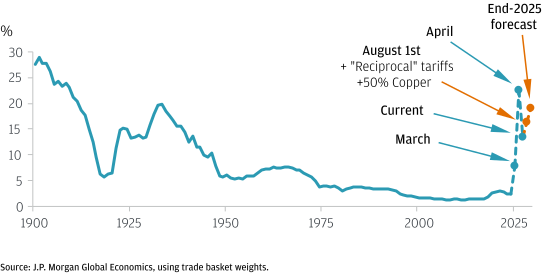
The rule of thumb that many have used as a benchmark is that a 1% increase in tariffs will raise inflation by 10 basis points and hinder GDP growth by 5 basis points. Since tariffs were roughly 2% last year and are about 11% now, that translates into 0.8% on inflation and 0.4% on growth.
How does that compare to what we‘ve seen? There was a meaningful weakening in gross domestic product (GDP) growth during the first half of the year, much of it attributable to the turmoil around tariffs and trade. Consensus estimates for full-year GDP are now roughly 0.6 percentage points lower than they were during the lead up to Liberation Day. There are many other factors that affect GDP growth, but we believe a big slice of the downgrade is due to the uncertainty around trade.
For inflation, it’s reasonable to ascribe at least a few tenths of a percent of the current 2.9% inflation to cumulative tariff effects. Many forecasts suggest a slight uptick in inflation in the months ahead, even while we are seeing a slowdown in key areas such as housing and the labor market. We believe a good amount of the inflation increase is tariff related, which means that we‘re probably not that far off the rule of thumb estimates.(...)
Neither of these points spell an impending recession, in our view. Imports of goods are only 11% of U.S. GDP, so it would probably take something akin to “Liberation Day: Part 2” to really sink the U.S. economy. However, it does mean that inflation and growth are both being pushed in the wrong direction. It is difficult to determine the exact impact on consumer prices since the general weakening of the economy is pushing inflation in the other direction. This might allow some pundits to argue that tariffs don’t raise prices. But it’s still there in the underlying data and should give Federal Reserve officials cause for concern as the pressure for interest rate cuts increases.
https://www.capitalgroup.com/advisor/in ... onomy.htmland
It is worth noting that the economy is complex. As the impacts of tariffs ripple through the economy, other factors, like employment, interest rates and more can come into play and affect the economic state of the country.
Some impacts have been more directly linked to tariff costs. For example, in California, the governor’s office reported that businesses in the state incurred $11.3 billion in tariff costs from January to May 2025, which represents the highest burden of any state in the country. (10)
https://moneywise.com/news/economy/trum ... data-shows
I think Mookie would argue that his state of California has been hurt by tariffs. Furthermore, the trade disruptions may have hurt his wine business, but I was under the impression that most of his wines were sold in the US and not exported, but he never really mentioned that, to my recollection.
I have argued about the complex nature of the US Economy, so this quote offers another validation of my previous statements to that fact.
https://moneywise.com/news/economy/trum ... data-shows
and more:
Of course, some goods are hit harder by price increases than others. For example, apparel, coffee, tea and cameras have each seen prices rise by over 7%. Likewise, some sectors are seeing more impacts than others. (17)
For example, manufacturing might expand by 2.5% but the construction sector is expected to shrink by 3.8%. The agriculture industry is already seeing the impacts of tariffs on commodities like soybeans, with prices going up in response to retaliatory tariffs put in place by China. (18, 19, 20)
I think Mookie and/or Duk was arguing that the manufacturing sector was being hurt by Trump (or losing jobs; I cannot recall the EXACT point they were making, without reading more than I want to read in previous posts). This source predicts CONTRARY to what they were saying. To simplify, I think that both Duk and Mookie predicted that the "sky was falling." Clearly the US Economy met some "headwinds" but did not crash or have the dire outcomes they predicted in Nov 2024 or Jan 2025.
In reading more data and analysis, I think it is safe to say:
1) lots of uncertainly on inflation and economic activity;
2) Some inflation (in the range of 2-3%) is likely;
3) Some economic improvement is likely (also in the 2-3% improvement in the GDP).
I think if the Fed and FOMC did not did not have confidence in their forecasts, they would NOT have reduced the Prime (interest rate) as they did for the month of December.
Federal Reserve lowers its benchmark interest rate by 0.25 percentage points in third straight cut
By Aimee Picchi
Updated on: December 10, 2025 / 3:59 PM EST / CBS News
The Federal Reserve on Wednesday cut its benchmark interest rate by 0.25 percentage points, bringing the federal funds rate to its lowest level in more than three years.
The reduction lowers the federal funds rate — what banks charge each other for short-term loans — to between 3.5% and 3.75%, down from its prior range of 3.75% to 4%. The Fed's decision marks the third consecutive rate cut since September, lowering the federal funds rate by a total of 0.75 percentage points this year.
Despite the lack of key government economic data because of the recent U.S. government shutdown, the Fed has been closely monitoring the slowdown in monthly job growth as well as rising inflation. Figures from ADP, which tracks private payrolls, showed that employers shed 32,000 jobs in November, a signal of continuing headwinds in the labor market.
https://www.cbsnews.com/news/federal-re ... me-powell/




 . but f*ck me, that is bloody retarded.